English
- English
- Español
- Português
- русский
- Français
- 日本語
- Deutsch
- tiếng Việt
- Italiano
- Nederlands
- ภาษาไทย
- Polski
- 한국어
- Svenska
- magyar
- Malay
- বাংলা ভাষার
- Dansk
- Suomi
- العربية
- हिन्दी
- Pilipino
- Türkçe
- Gaeilge
- Indonesia
- Norsk
- تمل
- český
- ελληνικά
- український
- Javanese
- فارسی
- தமிழ்
- తెలుగు
- नेपाली
- Burmese
- български
- ລາວ
- Latine
- Қазақша
- Euskal
- Azərbaycan
- Slovenský jazyk
- Македонски
- Lietuvos
- Eesti Keel
- Română
- Slovenski
- मराठी
- Srpski језик

News
How to Choose Stadium LED Display for Sports Venue?
Lighting conditions at sports events are complex, involving sunlight, rain, player collisions, and the broadcast of high-speed action—conditions that standard outdoor LED screens struggle to handle. As a critical medium for live event broadcasts, score displays, and advertising in sports venues, the selection of a Stadium LED Display should not be based solely on price; brightness, protection rating, impact resistance, and refresh rate are all key considerations.
I. Distinguishing Between the Two Main Types of Stadium LED Displays
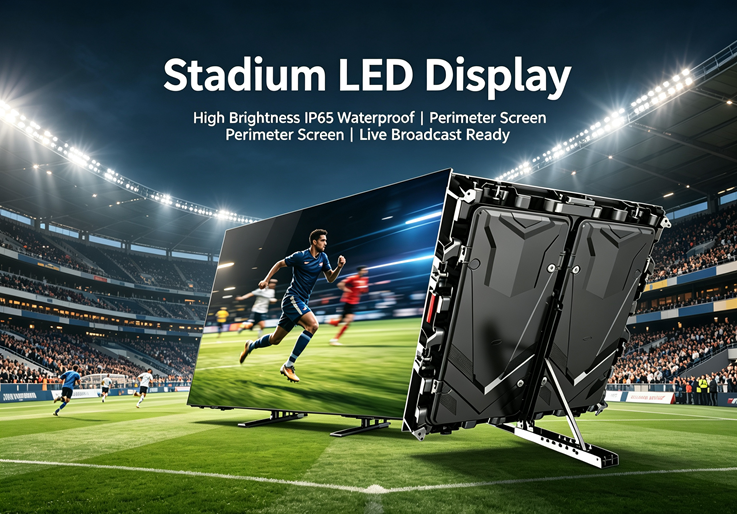
Stadium Perimeter LED Display: Installed along the perimeter fencing surrounding the playing field, these are commonly used in soccer and basketball arenas and also serve as platforms for event advertising. They must feature an impact-resistant structure to prevent damage from athletes colliding with the screen, while also offering a wide viewing angle so that spectators in all areas of the stadium can see the display clearly.
Fixed Stadium LED Screen: Suspended or mounted above the stands, these screens are primarily used for live event broadcasts, score displays, and highlight replays. They demand higher image quality and refresh rates and are generally larger in size.
II. Four Key Considerations for Selection
1. High Brightness to Adapt to Bright Outdoor Environments
Most stadiums are open-air or semi-open-air, with screens exposed to direct sunlight during the day. Select a High-Brightness Waterproof Stadium LED Display with a brightness of 5,500 cd/m² or higher to prevent the image from appearing washed out and illegible; it should also support automatic brightness adjustment, automatically reducing brightness on cloudy days and at night to conserve energy.
2. All-Weather Protection to Withstand Harsh Conditions
Outdoor LED screens for stadiums must meet the IP65 waterproof and dustproof rating to withstand heavy rain, dust, and daily temperature fluctuations. Circuit boards must undergo moisture-proof and anti-corrosion treatment to prevent screen blackouts or distortion caused by high temperatures, direct sunlight, or moisture intrusion.
3. High Refresh Rate to Ensure High-Quality Live Broadcasts
Sports events feature fast-moving action and require broadcast-quality footage for camera transmission. Selecting a High Refresh Rate Stadium LED Display for Live Broadcasts effectively eliminates moiré patterns and motion blur, ensuring clear and smooth visuals of high-speed players and balls, thereby meeting the dual demands of both on-site viewing and televised broadcasts.
4. Impact-Resistant Design
Stadium perimeter screens are located in high-risk contact zones; prioritize the use of an “Anti-Collision Stadium Perimeter LED Screen” equipped with impact-absorbing cushioning structures on the housing. Without such protection, the screens are highly susceptible to being struck by athletes during matches, resulting in module damage and increased maintenance costs.
III. Simple Pixel Pitch Reference
Fixed Stadium LED Screens for Close-Range Stands: P2.5, P3.0;
Stadium Perimeter LED Displays for Medium to Large Stadiums: P4, P5, P6;
Stadium LED Displays for Extra-Large, Long-Distance Outdoor Venues: P8, P10.
In summary, Allenson Stadium LED Displays are specifically optimized for sports applications and are divided into the Perimeter Anti-Collision Series and the Fixed Stand Series. These products are High-Brightness Waterproof Stadium LED Displays, featuring IP65 all-weather protection, high-brightness automatic dimming, and high refresh rates with no motion blur. The perimeter fence model is the standard Anti-Collision Stadium Perimeter LED Screen, widely used in soccer fields, track and field stadiums, and basketball arenas. It reliably handles event replays, real-time scoring, and commercial advertising, providing an integrated display solution for all types of sports venues.
Related News
- How Do Stadium LED Displays Balance Viewing Quality and Durability?
- How to Choose an LED Floor Tile Display for Stage Interactions?
- What advantages can you gain by purchasing flexible LED displays directly from the manufacturer?
- What Makes Antibacterial Toilet Bowl Cleaner Essential for a Hygienic Bathroom?
- What Makes a P6 Rental Display Screen the Right Choice for Large Events?
- How Can p2 Fine-Pitch LED Display Modules Transform Indoor Visual Experiences with Ultra-Clear Image Quality
Leave me a message