English
- English
- Español
- Português
- русский
- Français
- 日本語
- Deutsch
- tiếng Việt
- Italiano
- Nederlands
- ภาษาไทย
- Polski
- 한국어
- Svenska
- magyar
- Malay
- বাংলা ভাষার
- Dansk
- Suomi
- العربية
- हिन्दी
- Pilipino
- Türkçe
- Gaeilge
- Indonesia
- Norsk
- تمل
- český
- ελληνικά
- український
- Javanese
- فارسی
- தமிழ்
- తెలుగు
- नेपाली
- Burmese
- български
- ລາວ
- Latine
- Қазақша
- Euskal
- Azərbaycan
- Slovenský jazyk
- Македонски
- Lietuvos
- Eesti Keel
- Română
- Slovenski
- मराठी
- Srpski језик

News
What protective features should outdoor sports field displays have?
Outdoor sports field displays are constantly exposed to the elements—wind, sunlight, rain, and extreme day-to-night temperature fluctuations—as well as dust and lightning. Their protective performance directly determines whether the screens can reliably handle live event broadcasts, score displays, and advertising, making it a key factor to verify during the procurement and selection process. Let’s explore this in detail with the Allenson editorial team.
First is waterproofing and dustproofing, with the mainstream standard being an IP65 protection rating. IP65 indicates complete dust protection, preventing dust and sand from the field from entering the cabinet; the front modules can withstand rain spray, so there’s no need to worry about water ingress or short circuits even during heavy rain. Water is frequently sprayed around the field to maintain the turf, resulting in high humidity. High-quality outdoor sports field displays address this by ensuring details such as potting the modules, sealing the enclosure, and using waterproof connectors, thereby eliminating the risk of water seepage at the source.
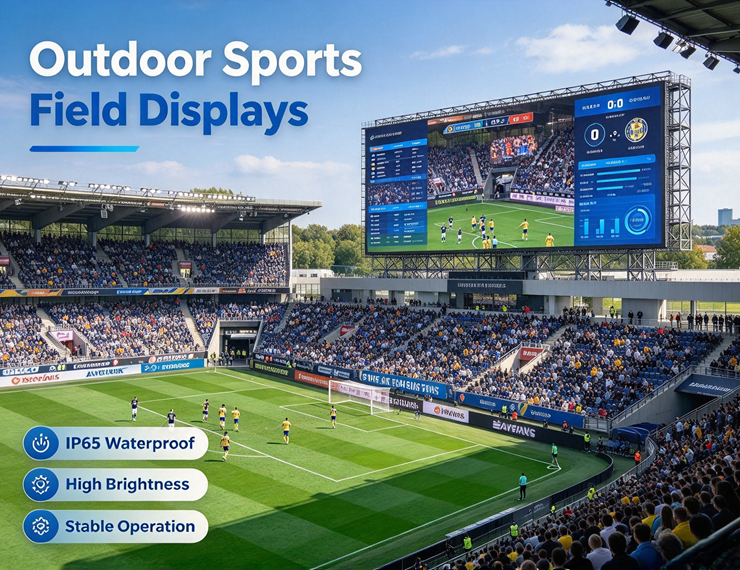
Second is wide-temperature protection against extreme heat and cold. Temperature fluctuations are particularly pronounced in open-air venues; in summer, the screen’s surface temperature rises sharply under intense sunlight, while low temperatures and frost in winter can also affect electronic components. Qualified outdoor sports field displays must support wide-temperature operation, typically functioning stably within the range of -40°C to +60°C. They are equipped with independent cooling ducts to dissipate heat rapidly in high temperatures, and in cold environments, optional temperature-controlled heating modules can be installed to prevent fogging and LED failure, ensuring normal image display year-round.
Lightning and surge protection is an indispensable feature for sports field displays. Sports fields are typically located in open, unobstructed areas with wide-open views, making them high-risk zones for lightning strikes. The screen’s power supply and signal systems must be equipped with multi-level lightning protection modules—divided into power supply and signal protection—to effectively mitigate surge impacts caused by induced lightning, prevent chips and power supplies from being damaged by instantaneous high voltage, and reduce the risk of malfunctions during thunderstorms.
Corrosion resistance and protection against UV-induced aging are also essential. Prolonged exposure to intense UV light accelerates the aging and yellowing of the screen covers and plastic components, causing the covers to fade and become brittle. Outdoor sports field displays use UV-resistant materials that are resistant to UV radiation and aging; they also feature anti-salt fog and anti-corrosion treatments. For sports fields near the coast, anti-salt fog solutions can be upgraded to withstand salt erosion from sea breezes, ensuring that colors do not fade significantly over time.
Additionally, protection against moisture and condensation is provided. When there are significant day-night temperature differences, condensation can easily form inside the cabinet; moisture adhering to circuit boards will gradually corrode the wiring. In addition to a sealed structure, some high-end sports field displays are equipped with dehumidification and temperature control devices to reduce internal condensation and prevent circuit oxidation. At the same time, the cabinet structure possesses a certain level of wind resistance, designed and reinforced according to local wind pressure standards to withstand strong winds, prevent screen swaying, and avoid structural damage.
In summary, if you are looking for outdoor sports field displays that offer reliable protection and seamless integration with sports venue systems, please feel free to contact Allenson. With extensive experience in outdoor sports LED display projects, Allenson can customize protection solutions based on the venue’s geographical environment, wind pressure, and temperature and humidity conditions. We provide one-stop services—including site surveys, production, installation, and commissioning—suitable for a wide range of projects, including school sports fields, athletic venues, and sports parks.
Related News
- In which scenarios are all-in-one digital signage displays suitable for use?
- What common pitfalls should you avoid when purchasing indoor fine-pitch displays?
- High-Quality Conference Displays: How to Choose an Indoor LED Display?
- What are the advantages of purchasing outdoor LED displays directly from the manufacturer?
- How to Choose a Manufacturer for Stadium LED Displays: Key Tips for Avoiding Pitfalls in Project Procurement?
- How Do Stadium LED Displays Balance Viewing Quality and Durability?
Leave me a message



News Recommendations