English
- English
- Español
- Português
- русский
- Français
- 日本語
- Deutsch
- tiếng Việt
- Italiano
- Nederlands
- ภาษาไทย
- Polski
- 한국어
- Svenska
- magyar
- Malay
- বাংলা ভাষার
- Dansk
- Suomi
- العربية
- हिन्दी
- Pilipino
- Türkçe
- Gaeilge
- Indonesia
- Norsk
- تمل
- český
- ελληνικά
- український
- Javanese
- فارسی
- தமிழ்
- తెలుగు
- नेपाली
- Burmese
- български
- ລາວ
- Latine
- Қазақша
- Euskal
- Azərbaycan
- Slovenský jazyk
- Македонски
- Lietuvos
- Eesti Keel
- Română
- Slovenski
- मराठी
- Srpski језик

News
How to Choose a Custom-Shaped Large Screen? Key Considerations for Circular LED Display Applications and Selection
Today, exhibition halls, science museums, and commercial complexes all favor custom-shaped display designs. With their unique curved shapes, circular LED displays break free from the constraints of traditional rectangular screens to create highly impactful, immersive visual effects. However, since circular LED displays are custom-made non-standard products, many procurement and engineering teams often encounter pitfalls, such as large seams between panels, image distortion, poor installation fit, and difficulties with post-installation maintenance. To ensure a successful project outcome, it is essential to clearly understand the corresponding application scenarios and key selection criteria.
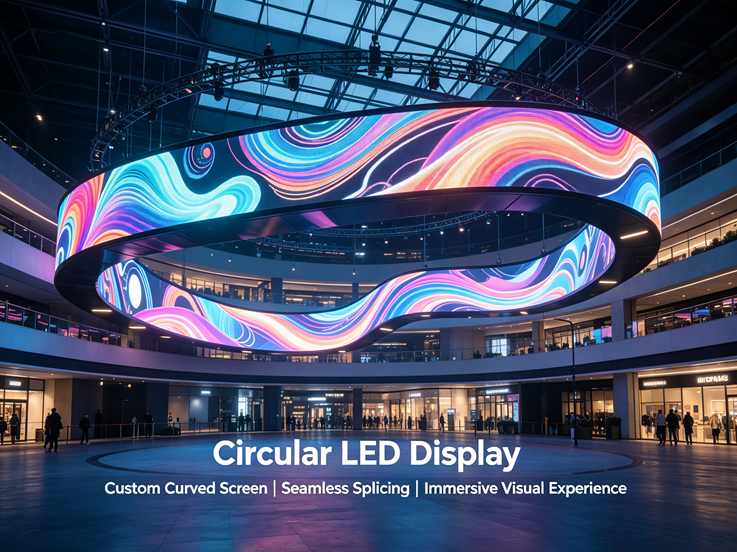
First, let’s clarify the mainstream application scenarios for circular LED displays. Corporate showrooms are often used for corporate branding and data visualization; science centers and museums rely on circular screens to create interactive exhibits that enhance the visitor experience; and commercial venues can use them in atriums, exhibition booths, and Instagrammable spots to display advertising content. Different scenarios have entirely different requirements for curvature, size, and image quality. The first step in selection is to clearly define the project’s purpose—do not blindly copy solutions from other projects.
Paying attention to the module splicing process is key. Circular LED displays rely on standard modules for curved assembly; poor craftsmanship can result in noticeable seams and image distortion. Prioritize modules that support flexible curvature adjustment to ensure smooth surface transitions. Small-sized circular screens, intended for close-up indoor viewing, should use fine-pitch products to eliminate a grainy appearance; for large-sized circular screens in atriums, where viewing distances are greater, the pixel pitch can be moderately increased to control overall project costs.
Pay close attention to structural and installation requirements. Circular displays place high demands on steel structural frames, requiring custom-designed mounting brackets tailored to the on-site space. For indoor projects, verify the ceiling height and load-bearing capacity; for certain suspended large circular displays, calculate the total weight in advance to avoid safety hazards during installation. Do not directly apply steel structure solutions designed for standard LED displays to prevent screen deformation later on.
Do not overlook the need to match brightness to content. Since most circular LED displays are used in indoor environments, brightness should not be set too high to prevent glare. Additionally, on curved circular screens, playing standard flat-screen video directly will result in image stretching and distortion; a specialized playback control system is required to perform curved surface correction, ensuring that portraits, text, and graphics are displayed correctly.
The difficulty of future maintenance must also be considered. Repairing non-rectangular screens is more complex than repairing standard rectangular ones. Prioritize products with front-access maintenance structures, which allow for individual module replacement without dismantling the entire steel structure, thereby reducing maintenance costs in exhibition halls and at high-altitude locations.
In summary, selecting the right manufacturer is crucial for achieving the desired results in non-standard-shaped projects. Allenson offers customized circular LED display solutions featuring proven curved splicing technology that effectively minimizes seams. We provide custom steel structures and specialized playback control and debugging services, supporting customization for various diameters and curvatures. Our solutions are suitable for a wide range of settings—including exhibition halls, museums, and commercial atriums—balancing display quality with ease of maintenance to ensure the successful implementation of non-standard-shaped large-screen projects.
Related News
- What are the advantages of purchasing outdoor LED displays directly from the manufacturer?
- How to Choose a Manufacturer for Stadium LED Displays: Key Tips for Avoiding Pitfalls in Project Procurement?
- How Do Stadium LED Displays Balance Viewing Quality and Durability?
- How to Choose an LED Floor Tile Display for Stage Interactions?
- What advantages can you gain by purchasing flexible LED displays directly from the manufacturer?
- What Makes Antibacterial Toilet Bowl Cleaner Essential for a Hygienic Bathroom?
Leave me a message