English
- English
- Español
- Português
- русский
- Français
- 日本語
- Deutsch
- tiếng Việt
- Italiano
- Nederlands
- ภาษาไทย
- Polski
- 한국어
- Svenska
- magyar
- Malay
- বাংলা ভাষার
- Dansk
- Suomi
- العربية
- हिन्दी
- Pilipino
- Türkçe
- Gaeilge
- Indonesia
- Norsk
- تمل
- český
- ελληνικά
- український
- Javanese
- فارسی
- தமிழ்
- తెలుగు
- नेपाली
- Burmese
- български
- ລາວ
- Latine
- Қазақша
- Euskal
- Azərbaycan
- Slovenský jazyk
- Македонски
- Lietuvos
- Eesti Keel
- Română
- Slovenski
- मराठी
- Srpski језик

News
Having trouble choosing a double-sided LED display? Read this article to say goodbye to blind purchasing.
Don’t many businesses and project managers tend to run into pitfalls when purchasing double-sided LED displays? Some blindly pursue ultra-high brightness, leading to wasted energy; others choose the wrong installation style, resulting in displays that can’t be used after installation; and still others fail to distinguish between suspended and pole-mounted models, ultimately facing issues like image desynchronization, installation limitations, and water ingress failures outdoors. In reality, selecting the right double-sided LED display isn’t complicated—there’s no need to place orders based on gut feeling. By selecting the right installation method, application scenario, protection rating, and display features, you can find a cost-effective solution on the first try and say goodbye to blind purchasing once and for all.
I. Suspended vs. Pole-Mounted Double-Sided Displays: How to Choose?
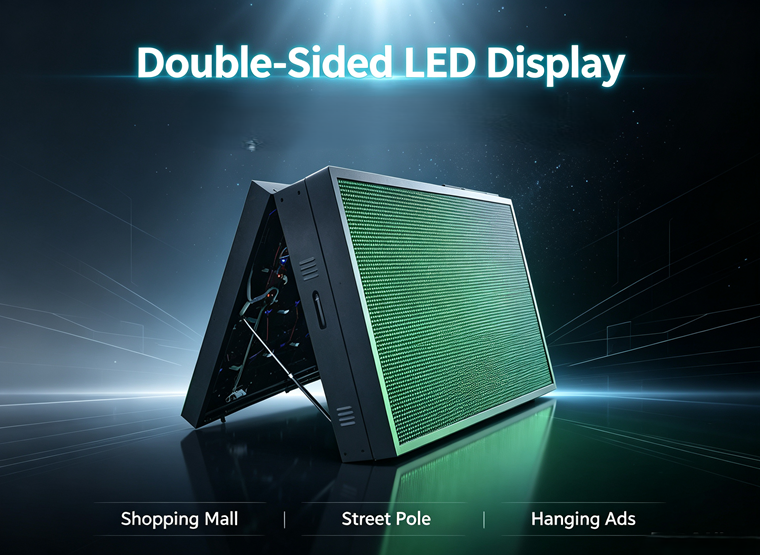
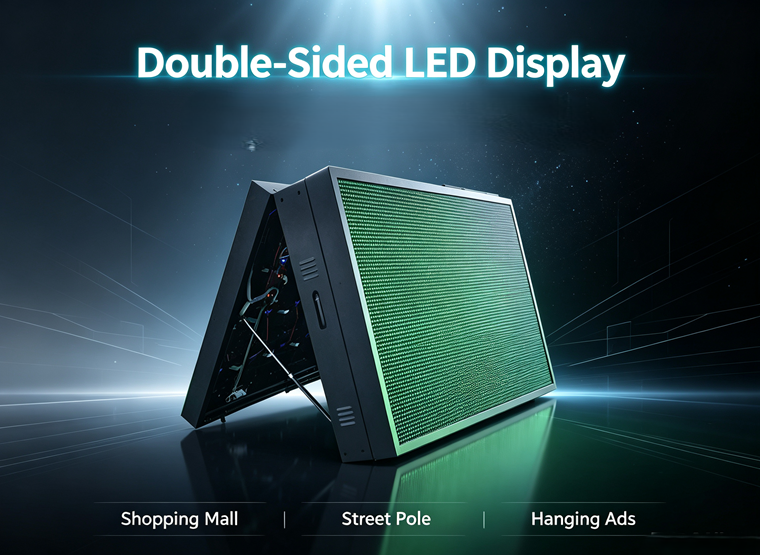
Many people get hung up on the model right from the start of the purchasing process. In reality, the two types are suited for completely different scenarios; choosing the wrong one not only affects aesthetics but also increases installation costs. Suspended double-sided LED displays are designed for overhead installation and are suitable for shopping mall atriums, exhibition hall corridors, and indoor open spaces. They do not occupy floor space and offer a dual-sided, unobstructed view, making them ideal for brand exposure and atmospheric lighting effects. This is the preferred choice for indoor commercial settings. Pole-mounted double-sided LED displays are designed for fixed, ground-level installation and are suited for outdoor settings such as city streets, scenic area intersections, store entrances, and park signage. They can withstand outdoor weather conditions and are ideal for long-term, fixed advertising and directional signage. Selecting the right model based on the installation environment is the key to choosing the right double-sided display.
II. How Should Parameters Be Matched for Indoor and Outdoor Settings?
What specifications should be chosen for indoor commercial settings? For shopping malls, exhibition halls, and suspended installations in atriums, ultra-high brightness is unnecessary; standard brightness levels of 800–1,000 cd/m² are sufficient. This provides soft, non-glare lighting for a better viewing experience. Prioritize P2.5 or P3 pixel pitches for fine image detail and uniform color, meeting the needs of customers viewing at close range while offering better value for money—ideal for long-term, routine displays.
How should you choose a more durable option for outdoor advertising scenarios? For street poles, outdoor scenic areas, and open-air storefronts, protection must be the top priority. Be sure to select a Double-Sided LED Display with IP65 dust and water resistance to withstand harsh weather conditions such as rain, snow, dust, and intense sunlight. In bright outdoor environments, we recommend high-brightness models with 4,500 cd/m² or higher. Even under direct midday sunlight, the display will not wash out or become illegible, ensuring clear visibility around the clock.
What should you consider for multifunctional applications? If you need to display different content on each side of a double-sided screen, be sure to confirm in advance that the equipment supports independent control of both screens. Many standard double-sided screens can only play content synchronously on both sides and cannot be used for dual purposes. Custom models with independent control, however, allow one side to display brand advertisements while the other shows directional information, doubling the utility of a single unit and making them ideal for multifunctional settings such as commercial districts, tourist attractions, and transportation hubs.
III. Avoiding Pitfalls During Procurement: The Most Easily Overlooked Details of Double-Sided Screens
Why do some double-sided LED displays malfunction after just six months of use? Most issues stem from oversights in the selection process. First, consider the cabinet material: prioritize lightweight die-cast aluminum cabinets, which are sturdy, resistant to deformation, require less load-bearing capacity for suspension, and offer superior wind resistance for outdoor use. Second, examine playback modes—select synchronized playback or independent control based on your needs to ensure the functionality aligns with your requirements. Finally, assess compatibility: for outdoor settings, verify the IP rating; for indoor settings, prioritize slim models for easier installation and a more aesthetically pleasing appearance. Also, prioritize screens with high refresh rates to ensure stable, flicker-free images and prevent “water ripple” effects in photos and videos.
In summary,For indoor malls and exhibition hall lighting, choose slim, suspended models with P2.5/P3 standard brightness; for outdoor pole-mounted displays, storefronts, and scenic area advertisements, select IP65 waterproof, high-brightness outdoor models; For multifunctional displays, prioritize standalone, independently controlled double-sided screens. There’s no need to blindly pursue high specifications—aligning with the installation scenario, matching usage requirements, and fitting within your budget is the optimal procurement solution for Double-Sided LED Displays. As a direct manufacturer, Allenson offers one-stop services including double-sided screen customization, site surveys and design, installation, and after-sales support. All screen models undergo aging tests before leaving the factory, ensuring stable quality and suitability for various commercial and municipal lighting projects.
Related News
- What are the advantages of purchasing outdoor LED displays directly from the manufacturer?
- How to Choose a Manufacturer for Stadium LED Displays: Key Tips for Avoiding Pitfalls in Project Procurement?
- How Do Stadium LED Displays Balance Viewing Quality and Durability?
- How to Choose an LED Floor Tile Display for Stage Interactions?
- What advantages can you gain by purchasing flexible LED displays directly from the manufacturer?
- What Makes Antibacterial Toilet Bowl Cleaner Essential for a Hygienic Bathroom?
Leave me a message