English
- English
- Español
- Português
- русский
- Français
- 日本語
- Deutsch
- tiếng Việt
- Italiano
- Nederlands
- ภาษาไทย
- Polski
- 한국어
- Svenska
- magyar
- Malay
- বাংলা ভাষার
- Dansk
- Suomi
- العربية
- हिन्दी
- Pilipino
- Türkçe
- Gaeilge
- Indonesia
- Norsk
- تمل
- český
- ελληνικά
- український
- Javanese
- فارسی
- தமிழ்
- తెలుగు
- नेपाली
- Burmese
- български
- ລາວ
- Latine
- Қазақша
- Euskal
- Azərbaycan
- Slovenský jazyk
- Македонски
- Lietuvos
- Eesti Keel
- Română
- Slovenski
- मराठी
- Srpski језик

News
Does a higher light transmittance on LED transparent screens result in a blurrier image?
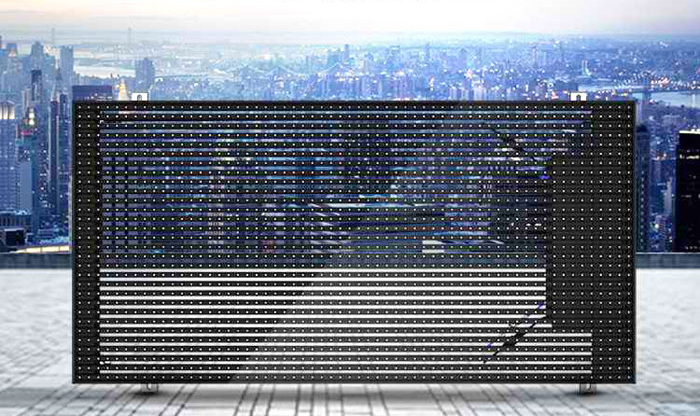
In the application scenarios of LED transparent screens, a common question arises: Does higher light transmittance lead to blurrier images? The core of this issue lies in whether there is an inherent trade-off between light transmittance and image clarity. In reality, there is no absolute inverse relationship between the two. However, this contradiction was common under traditional conventional technologies. With technological advancements, it is now possible to achieve both high light transmittance and sharp image quality. Let's explore this in detail.

This can be understood through two key aspects:
Common in traditional technology: Early LED transparent screens achieved higher light transmission primarily by increasing the spacing between LEDs and using hollow or strip-shaped module structures. Higher light transmission meant sparser LED distribution on the screen surface and fewer light-blocking structural components. However, image clarity depends on pixel density. Sparse LEDs directly reduce pixel density, leading to noticeable graininess and blurred details when viewed up close. For instance, some early transparent screens with over 80% light transmission had large pixel pitches, causing text edges to appear blurred during playback. This is why many people believe “higher light transmission means blurrier images.”
Technological Advancements Addressing Both: Through innovation, the trade-off between light transmission and clarity has been overcome. On one hand, micro-LEDs and precision packaging techniques—such as using small-sized LEDs like SMD1921—enable denser pixel placement within limited screen space. This reduces light-blocking areas to enhance transparency while maintaining high pixel density. For instance, some high-end LED transparent screens achieve over 90% light transmittance while maintaining a small pixel pitch, significantly boosting pixel density and image clarity. On the other hand, pairing transparent substrates with optimized technologies—such as crystal film displays using bare-chip mounting—eliminates traditional light bar structures. Instead, transparent crystal film sheets serve as the light panel, enhancing light transmittance while preventing structural components from obscuring the image. Furthermore, some products incorporate anti-reflective coatings and boost brightness to over 5000 cd/m², counteracting external light interference to maintain vivid, clear visuals even at high transparency levels.
For instance, a premium automotive brand's showroom utilizes a 90% light transmission LED transparent screens. This allows visitors to clearly see the vehicles displayed behind the screen while simultaneously presenting dynamic promotional videos without blurring, achieving seamless integration between content and background scenery.
Overall, the technological evolution of LED transparent screens—from the early trade-off between light transmission and clarity to the current integration of micro-LEDs, transparent substrates, and anti-interference technologies—has fundamentally redefined the industry's perception that “high transparency inevitably leads to blurriness.” Take the 90% light transmittance LED transparent screen in a premium automotive showroom as an example. It not only fully reveals the details of the displayed vehicles but also seamlessly integrates high-definition dynamic visuals with the background scenery, demonstrating how technological advancements can revolutionize the visual experience. Looking ahead, with the widespread adoption of cutting-edge technologies like flexible displays and dynamic light transmission adjustment, LED transparent screens will achieve the ultimate goal of “boundless light transmission and infinite clarity” across an expanding range of applications.
Related News
- What are the advantages of purchasing outdoor LED displays directly from the manufacturer?
- How to Choose a Manufacturer for Stadium LED Displays: Key Tips for Avoiding Pitfalls in Project Procurement?
- How Do Stadium LED Displays Balance Viewing Quality and Durability?
- How to Choose an LED Floor Tile Display for Stage Interactions?
- What advantages can you gain by purchasing flexible LED displays directly from the manufacturer?
- What Makes Antibacterial Toilet Bowl Cleaner Essential for a Hygienic Bathroom?
Leave me a message